
In the modern industrial landscape, cleanliness isn’t just about aesthetics—it’s about operational efficiency, equipment longevity, and environmental responsibility. Among the various technologies available, dry ice blasting has emerged as the gold standard for non-destructive, eco-friendly surface preparation. Whether you are in food processing, automotive restoration, or power generation, choosing the right equipment is a critical investment.
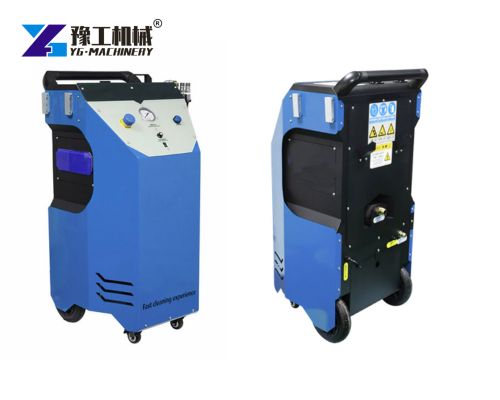
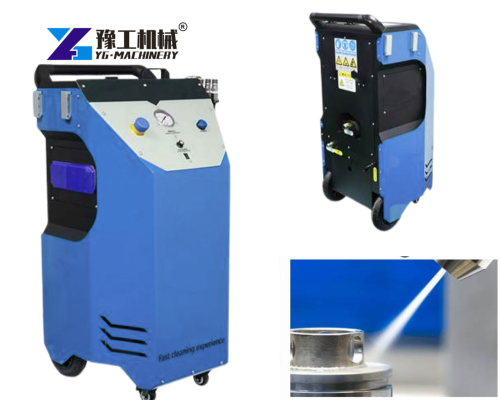
Proudly made in China, YG dry ice blaster equipment is available for purchase directly or through an extensive network of distributors, with 3kg, 6kg, 15kg, 40kg ice capacity options also provided.
Request Custom Dry Ice Blaster Quote
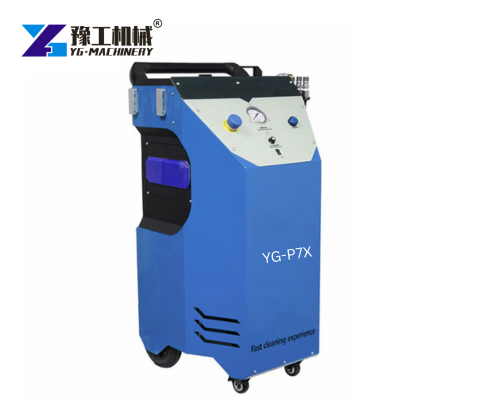
Available Small Dry Ice Blasting Machine in YG
| Model | YGMINI | YGP7X(hot-sale) | YGA625 | YGT6 | YGP8S |
| Motor power | 42W | <500W | 750W | 0.36KW | 750W |
| Voltage | AC220V/50-60HZ | AC220V, 50-60HZ | AC220V, 50-60HZ | AC220V/50-60HZ | AC220V, 50-60HZ |
| Air consumption | 0-2m³/min | 28-106 CFM (0.8-3.0m³/min) adjustable | 106-283CFM (3-8m3/min)(adjustable) | 28-141CFM (0.8-4.0m³min) | 3-8m³/min(adjustable) |
| Air supply pressure | 0.1-0.9Mpa | 0-1.6Mpa | 0.1-0.8Mpa (1-8bar Adjustable) | 0.2-1.6Mpa | |
| Ice delivery speed | Particle spray rate: 0.01-0.13 kg/min; Powder spray rate: 0.01-0.08 kg/min | 0-0.75kg/min(adjustable) | 0-7.9 Ibs/min (0-3.6Kg/min)(adjustable) | 0-1.2 lbs/min (0-0.55Kg/min)Adjustable | 0-3.6kg/min(adjustable) |
| Hopper capacity | 3.2Kg | 10.5kg (23.5 lbs) | 25kg | Max. 22lbs(Max. 10Kg) | 25kg |
| Hopper size | 0.3m³ | ||||
| Degree of protection | IP54 | IP54 | IP52 | IP54 | |
| Machine weight | 9Kg | 55kg | 65kg | 121lbs(55Kg) | 65kg |
| Dry ice state | 2.5-3mm (granular) | 2.5-3mm | 2.5-3mm, granular | 120*120*250mm(about 5KG)/150*150*300mm(about 10KG) | 2.5-3mm, granular |
| Drive mode | Direct link | Direct connection | Direct link | Direct link(Dual motors drive the cutter and rollers independently) | Permanent magnet synchronous |
| Machine size | 310*185*320mm | 510*460*960mm | 440*680*80mm | 640*400*580mm | 440*680*780mm |
Request Custom Small Dry Ice Blasting Machine Quote
How Dry Ice Blasting Works: The Sublimation Process
Dry ice blasting relies on the unique properties of solid CO₂ and the process of sublimation to deliver powerful, residue-free cleaning. Unlike sandblasting or water blasting, it uses no harsh chemicals or abrasive media. Instead, dry ice pellets are accelerated by compressed air and shot at high velocity onto the surface.
The cleaning action happens in three key ways:
- Kinetic impact: The fast-moving pellets strike the surface, breaking up dirt, grease, or coatings.
- Thermal shock: At –78.5°C, the extreme cold makes contaminants brittle and weakens their bond to the material.
- Sublimation: On impact, solid CO₂ instantly turns into gas, expanding rapidly and lifting contaminants away without leaving any waste behind.
This combination makes dry ice blasting effective, non-damaging, and environmentally friendly for a wide range of industrial cleaning tasks.
Detailed Explanation of Equipment Components
As a manufacturer, we know that a dry ice blaster is only as good as its weakest component. To achieve “Best-in-Class” results, you need a synchronized ecosystem of hardware.
Ice Block Makers and Pelletizers
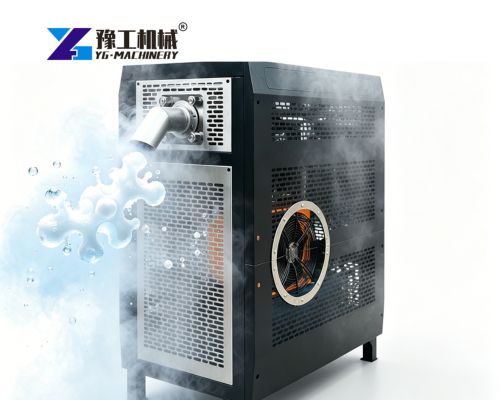
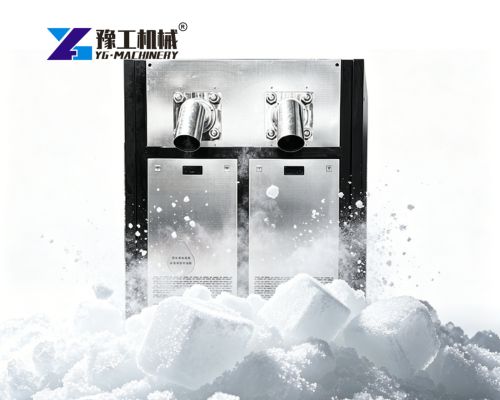
While many users buy pre-made pellets, high-volume industrial facilities often invest in Pelletizers. These machines convert liquid CO2 into solid “snow,” which is then compressed into 3mm pellets or larger blocks. Using “fresh” ice is a secret to superior cleaning; fresh pellets are harder and denser, providing better kinetic impact than “old” ice that has begun to sublimate in storage.
Inquire About Pelletizers for Fresh Dry Ice On-Demand
The Blasting Machine (The Core)
Modern units, such as the Commando line, are engineered to solve the industry’s biggest headache: “freeze-ups.” High-quality machines feature patented delivery systems (like BlitzFeed®) that ensure a non-clogging, pulse-free flow of ice. This allows for a consistent finish and prevents costly downtime caused by moisture ice-ups in the hopper.
High-Performance Air Compressors
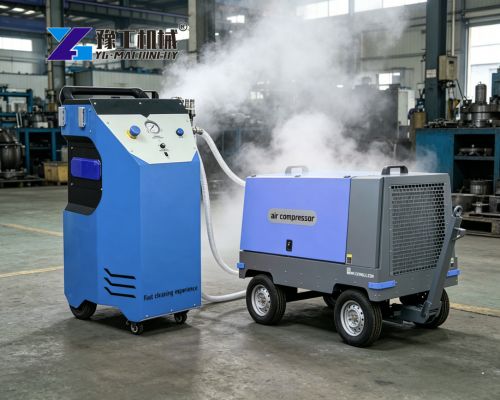
The air compressor is the “engine” of the operation. To run an industrial dry ice blaster, you generally need a compressor capable of delivering 80 to 250 CFM at pressures ranging from 50 to 150 PSI. If the air is weak, the pellets won’t reach the velocity needed for the “micro-explosion” effect.
Request Custom Dry Ice Blaster Quote
Specialized Accessories: Nozzles and Aftercoolers
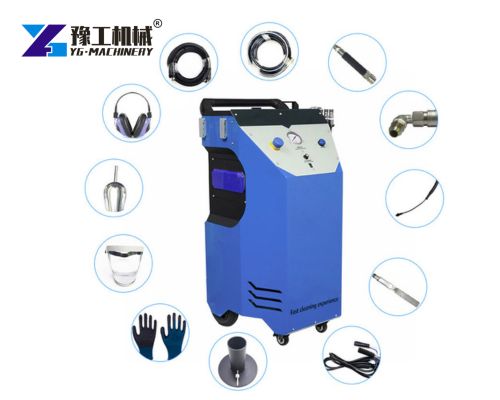
• Supersonic Nozzles: Designed with internal Venturi geometries to maximize pellet speed.
• The Aftercooler: This is non-negotiable for humid environments. A dedicated aftercooler removes moisture from the compressed air. If moisture enters the system, the dry ice will clump, and the machine will jam.
Request Custom Dry Ice Blaster Quote
What is Dry Ice Blasting and Why Use It?
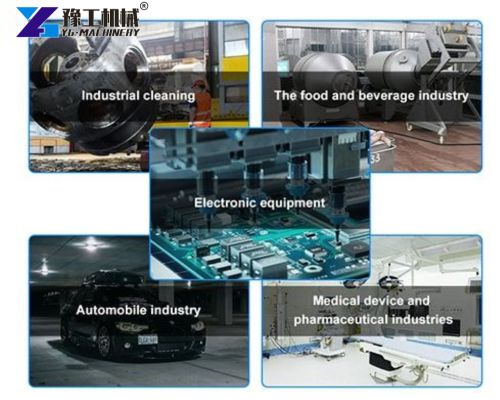
The shift toward “Green Manufacturing” has made dry ice blasting a preferred solution for Fortune 500 companies. It is a media-less process, meaning the cleaning agent simply disappears into the atmosphere after it hits the target.
The Four Pillars of Dry Ice Advantages:
- Non-Abrasive: Unlike sand or glass beads, dry ice does not wear down the substrate. You can clean a delicate chrome gear or a plastic mold without changing the tolerances or dulling the finish.
- Non-Conductive: Since CO2 is a gas, it is moisture-free and non-conductive. This allows for the “in-place” cleaning of electric motors, circuit breakers, and sensitive wiring without the risk of short circuits.
- Non-Toxic & Food Safe: It meets FDA, EPA, and USDA guidelines. There are no harsh solvents or chemicals involved, making it the only choice for food-contact surfaces.
- Zero Secondary Waste: This is the ultimate SEO keyword for industrial buyers. In sandblasting, if you use 100 lbs of sand, you have to clean up 100 lbs of sand plus the dirt. With dry ice, you only clean up the dirt that fell off.
Maintaining A Dry Ice Blasting Machine to Protect Your Investment
A dry ice blaster is a precision instrument. To ensure your “Best Dry Ice Blaster” stays that way, a rigorous maintenance schedule is required.
Key Maintenance Protocols:
• Moisture Management: 90% of machine failures are caused by wet air. Always drain your compressor tanks and check your aftercooler filters.
• Component Inspection: Unlike Dustless Blasting machines—which are designed for rugged, simple repairs—dry ice machines contain high-precision dosing discs and rotors. Regularly inspect these for “scoring” or wear.
• Lubrication: Moving parts in the feeding system must be kept lubricated with food-grade lubricants (if applicable) to prevent friction-related heat, which can cause pellets to sublimate prematurely inside the machine.
• Static Grounding: Dry ice blasting generates significant static electricity. Always ensure your grounding strap is securely attached to the substrate to prevent “shocks” to the operator or the control board.
Request Custom Dry Ice Blaster Quote
Key Considerations Before You Buy a Dry Ice Blasting Machine
Before you sign the purchase order, ask yourself these three questions:
1. What is my “Surface Sensitivity”?
If you are cleaning delicate electronics, you need a machine with highly adjustable pressure (down to 20 PSI). If you are cleaning heavy slag off a mold, you need a high-flow machine that can handle 100+ PSI.
2. What is my “Contaminant Profile”?
Hard, brittle contaminants (like carbon or paint) respond best to dry ice. Soft, elastic contaminants (like some glues or thick bitumen) may require a “shaved ice” machine rather than a “pellet” machine to increase the surface area of the impact.
3. What is my “Ice Supply” Logic?
Do you have a local dry ice supplier who can deliver fresh pellets daily? If not, you must factor in the cost of a Pelletizer or an on-site CO2 storage tank. YG can also provide you with dry ice making machines. Dry ice has a shelf life; it sublimates even in a cooler, losing about 5% to 10% of its mass every 24 hours.
How to Get Started with the Best in the Industry
Choosing the best dry ice blaster is about more than just the machine; it’s about the support team behind it. At YG Machinery, we provide the technical expertise to match the right machine to your specific industrial challenge.
Whether you need a portable unit for automotive detailing or a high-output system for a food production plant, YG is ready to guide you.
Contact Information:
Website: www.ygequipment.com
Phone/WhatsApp/Wechat: +86 159 3715 2330
Take the first step toward a cleaner, faster, and more sustainable future. Contact us today for a custom ROI analysis and equipment demonstration.