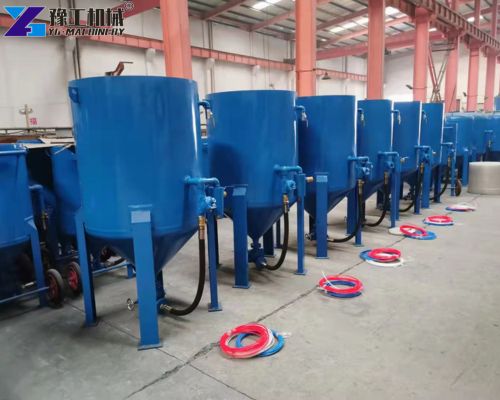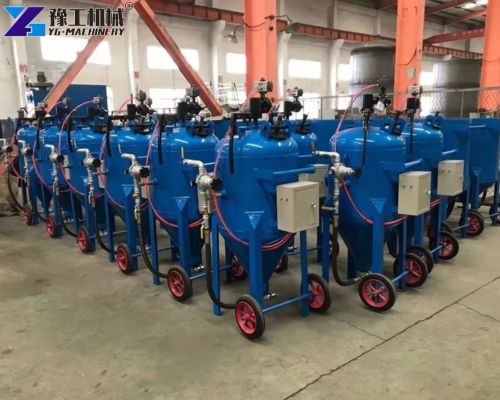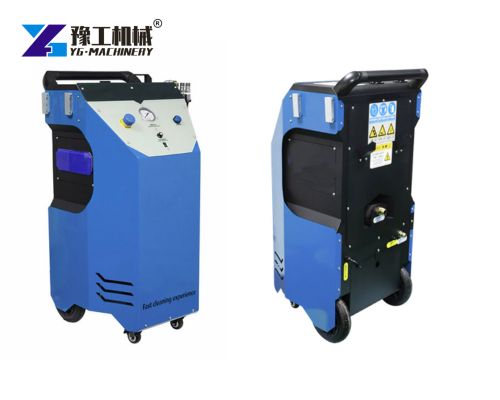
A portable sand blaster machine is a versatile, mobile power tool designed to remove rust, paint, and scale from various surfaces. Supporting both wet and dry sandblasting, YG industrial-grade portable sandblasting equipment is known for its compact mobility, durable high-pressure nozzles, and adjustable efficiency. These machines are essential for automotive restoration, bridge maintenance, and industrial steel surface preparation.
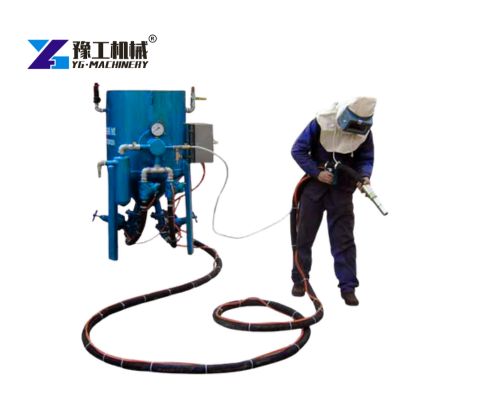
Get Portable Sand Blasting Machine Price
Portable Sand Blaster Machine Specifications
| Model | Tank Diameter (mm) | Tank Height (mm) | Plate Thickness (mm) | Volume (L) | Abrasive Capacity (kg) | Air Requirement (m³/min) |
| YG-400 | 400 | 1100 | 5 | 100 | 150-200 | 2-3 |
| YG-500 | 500 | 1200 | 5 | 150 | 250-300 | 3-4 |
| YG-600 | 600 | 1350 | 6 | 250 | 400-500 | 4-6 |
| YG-700 | 700 | 1500 | 6 | 400 | 600-800 | 6-8 |
| YG-800 | 800 | 1600 | 6 | 600 | 900-1100 | 8-10 |
| YG-900 | 900 | 1700 | 8 | 800 | 1200-1500 | 10-12 |
| YG-1200 | 1200 | 1900 | 8 | 1500 | 2000-2500 | 15-20 |
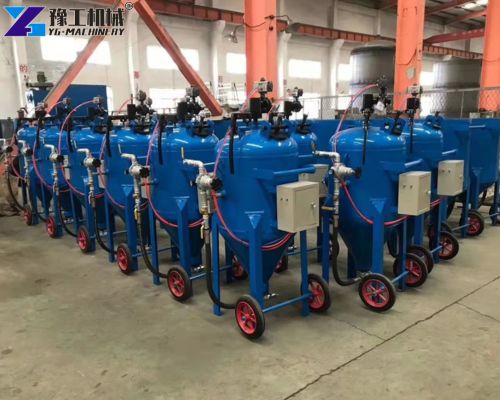
Note: Models from 400mm to 700mm include wheels for easy movement. Larger models use four legs for stability because they weigh over 300kg.
Available Small Sandblasting Machine in YG Machinery
Based on your working environment and workpiece requirements, we offer three primary types of small sandblasting machine:
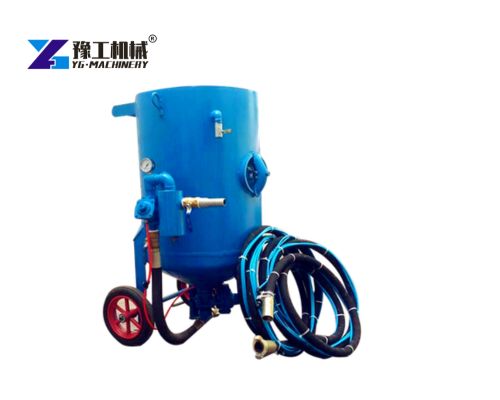
Dry Sandblasting Machines
- Operating Principle: Direct use of dry abrasive media for blasting.
- Applications: Iron and steel workpieces where moisture must be avoided.
- Advantages: Simple operation and prevents flash rusting on ferrous metals.
Water Sand Blasting Machine
- Operating Principle: A mixture of water and abrasive (typically 1:1 ratio) is pressurized and sprayed.
- Applications: Environments with strict dust-control regulations.
- Advantages: Eliminates dust pollution and provides a cleaner, eco-friendly workspace.
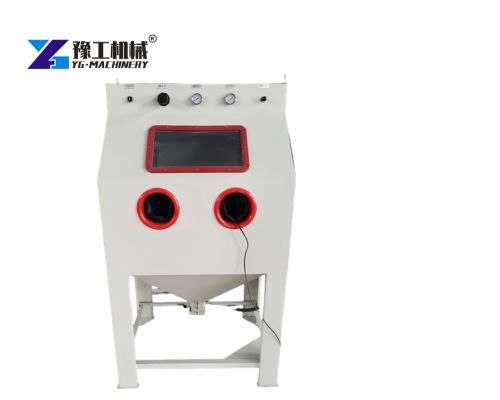
Cabinet Sandblasters
- Design: Features a fully enclosed working chamber to contain dust and media.
- Key Advantage: Solves the issue of flying dust in open environments and includes a media recycling system to reduce operational costs.
- Key Advantage: Solves the issue of flying dust in open environments and includes a media recycling system to reduce operational costs.
- Hot-sale Models: YG 9060 model is ideal for small parts (e.g., motorcycle components), while the YG100100 model is designed for larger workpieces.
Portable Sand Blaster Machine Industry Applications
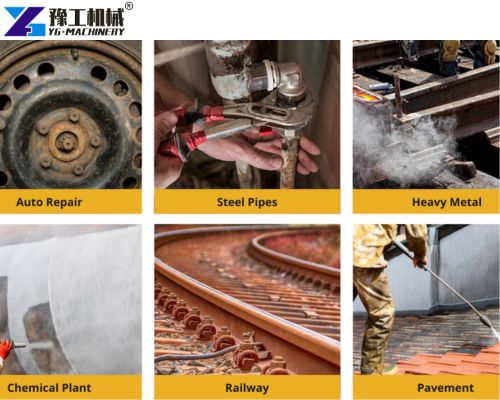
- Infrastructure: Shipbuilding, bridge construction, water conservancy, and port maintenance.
- Heavy Manufacturing: Mining machinery, oil & gas pipelines, and railway rolling stock.
- Surface Pre-treatment: Essential preparation before painting, powder coating, electroplating, and anodizing.
- Surface Pre-treatment: Essential preparation before painting, powder coating, electroplating, and anodizing.
Portable Sandblasting Equipment FAQ
A: There are two types of portable sand blasting machines.
Dry sandblasting machines require only abrasive media to operate.
The water sand blasting machine uses a 1:1 mixture of water and abrasive media. Suitable abrasives include emery, quartz sand, copper slag, brown fused alumina, and dust-free sand, with a maximum particle size of 1.2 mm (about the size of a millet grain).
A: The plate thickness varies by sandblasting model. Our portable sand blasting machines use high-quality Q235B carbon steel for durability.
For 400–500 type sandblasting machines: plate thickness is 5 mm.
For 600–800 type sandblasting machines: plate thickness is 6 mm.
For 900–1200 type sandblasting machines: plate thickness is 8 mm.
A: There are two common configurations:
Manual valve sandblasting machines: Cost-effective, but require two operators—one to hold the sandblasting gun and one to control the switch.
Pneumatic valve sandblasting machines: Equipped with an air switch on the gun, so only one operator is needed to control the entire process.
A: No. Larger sandblasting tanks only hold more abrasive media, extending the working time before refilling—but they do not increase blasting speed.
The standard efficiency is about 20–30 m² per hour, which mainly depends on the complexity of the workpiece. Flat panels process much faster than irregular workpieces.