
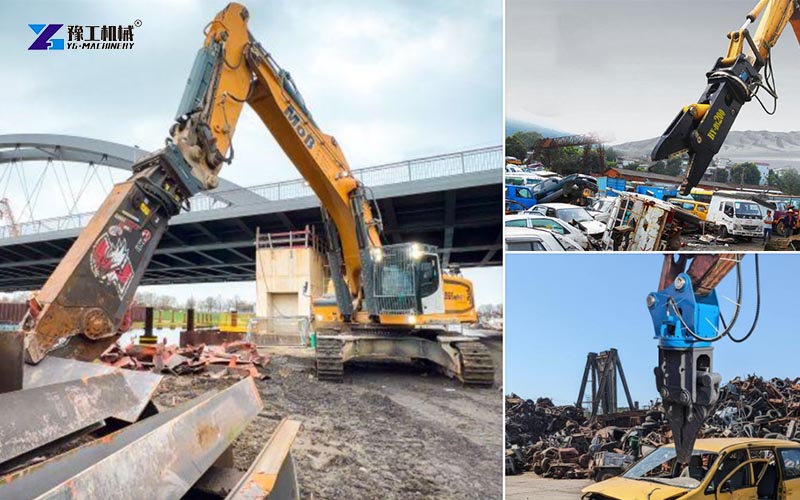
Most people size a hydraulic shear by looking at the jaw opening. That is the wrong end of the problem. The jaw only tells you what fits in the mouth. Your excavator decides whether the shear can lift, turn and cut without tipping, stalling or cracking the boom. Get the carrier match wrong and a perfectly good shear becomes an expensive paperweight. This guide walks through the four checks that actually decide the size: carrier weight, pin dimensions, working pressure and material.
Get Free Shear Matching Recommendation
Start With Carrier Weight, Not Jaw Size
A shear is an attachment, so the machine sets the ceiling. Three things on the carrier limit you.
- Lift capacity at reach. You are not just lifting the shear, you are lifting it with steel in the jaws, at full extension, while rotating.
- Hydraulic flow. A shear needs volume to close fast. Too little flow and the cycle drags, which costs you money on every cut.
- Stability. A heavy shear at maximum reach puts load on the wrong side of the tracks. On a small carrier this is the difference between cutting and tipping.
So the first number you look at is the excavator’s operating weight, not the shear’s jaw opening.
The 10 Percent Rule for Shear Weight
Across this range, the shear weighs roughly 9 to 10 percent of the carrier it is built for.
| Model | Shear weight | Carrier weight | Ratio |
| YG-620 | 620 kg | 5–9 t | 8.9% |
| YG-1413 | 1,413 kg | 10–19 t | 9.7% |
| YG-2200 | 2,200 kg | 20–25 t | 9.8% |
| YG-2977 | 2,977 kg | 28–35 t | 9.5% |
| YG-4052 | 4,052 kg | 38–50 t | 9.2% |
Add the mounting bracket and you are at 10 to 11 percent. That is the practical band: heavy enough to cut, light enough to keep your lift capacity for the material.
If you go above 12 percent, you feel it. The machine gets nose-heavy, the cycle slows down and the operator starts fighting the joystick instead of cutting.
Check the Pins Before You Check the Price
A shear that fits your weight class will not automatically fit your machine. Four dimensions decide whether it bolts on.
- Pin diameter. A 90 mm pin does not go into an 80 mm boss.
- Arm width. The gap between the boom ears varies by brand and by generation.
- Pin centre distance. Bucket-to-shear swaps need matching centres, or a custom bracket.
- Bracket style. Direct pin-on, quick coupler or a weld-on adaptor.
Measure these on the machine you actually own, not from a spec sheet. Pin dimensions change between model years even within one brand, and a bracket built to the wrong drawing costs you two weeks and a crane.
Match Working Pressure to Your Machine
Shear force scales with hydraulic pressure, so a pressure mismatch quietly costs you tonnage.
| Model | Working pressure |
| YG-620 | 235 bar |
| YG-1413 | 300 bar |
| YG-2200 / 2977 / 4052 | 320 bar |
If your excavator runs 250 bar and you buy a 320 bar shear, you do not get the rated bottom force. You get roughly 78 percent of it — enough to notice on thick I-beam, not enough to complain about on rebar.
Ask two questions before ordering: what is my main relief pressure, and what flow does my auxiliary circuit deliver at that pressure. Then match the model to those numbers.
Rotating or Fixed: Which One Do You Need?
Rotation is not a luxury feature. It changes how you work.
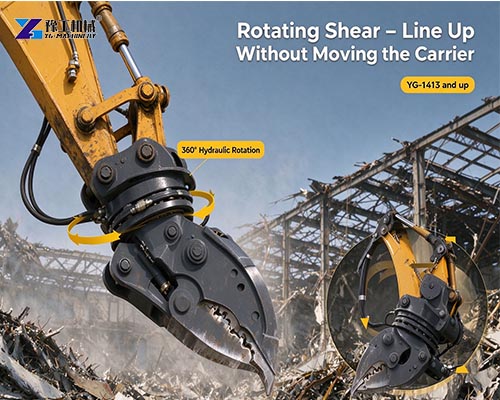
- 360 hydraulic rotation (YG-1413 and up). The shear turns independently of the carrier, so you can line up a cut in a tight yard without repositioning the tracks. On demolition and scrap loading this saves a full machine movement per cut.
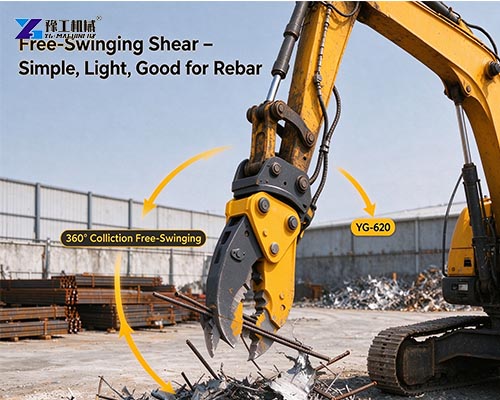
- 360 collision (free-swinging) (YG-620). The shear swings freely and finds its own angle as it contacts the material. Cheaper, lighter, fewer hoses. Good for rebar, mesh and light scrap where the operator works from above.
On a 5 to 9 tonne machine, free-swinging keeps the weight down and the plumbing simple. Above 10 tonnes, hydraulic rotation pays for itself quickly.
Match the Jaws to the Material
The right shear for rebar is not the right shear for a rail car.
- Rebar, mesh, light structural — narrow jaw, high bottom force, fast cycle. YG-620 and YG-1413 territory.
- I-beam, channel, plate — deep effective shear depth matters more than jaw width. YG-2200 and YG-2977.
- Heavy demolition, scrap processing, rail — YG-4052, where the 736 mm shear depth and 387 t bottom force do the work.
- Concrete with rebar — a shear cuts the steel but not the concrete. For slabs and columns you want a pulverizer or a crusher, and often both attachments.
Effective shear depth is the number most buyers ignore. It tells you how thick a section the blades will bite through in one stroke, and it is the real limit on plate and beam work.
YG Hydraulic Shear Specifications
| Product | Excavator-mounted hydraulic demolition shear for waster scrap rebar | ||||
| Item | YG-620 | YG-1413 | YG-2200 | YG-2977 | YG-4052 |
| Weight kg | 620 | 1413 | 2200 | 2977 | 4052 |
| Max. Open Size mm | 334.4 | 540 | 500 | 660 | 801 |
| Width mm | 864 | 1175 | 1370 | 1600 | 1700 |
| Height mm | 1521 | 2050 | 2380 | 2600 | 2700 |
| Effective Shear Depth mm | 286 | 348 | 486 | 578 | 736 |
| Rotating Way | 360 collision | 360 hydraulic | |||
| Working Pressure Bar | 235 | 300 | 320 | 320 | 320 |
| Bottom Shear Force T | 81.2 | 138.2 | 171.2 | 330.2 | 387.2 |
| Medium Shear Force T | 50.2 | 80.2 | 100.2 | 189.2 | 218.2 |
| Tip Shear Force T | 32.2 | 53.2 | 75.2 | 127.2 | 147.2 |
| Applied Excavator Weight T | 5-9 | 10-19 | 20-25 | 28-35 | 38-50 |
Read the table from the right column first: find your excavator weight, then check that the shear’s working pressure matches your relief setting.
Get a Hydraulic Shear for Your Project
What Oversizing Actually Costs
Buyers oversize because the next model up looks like more value. It usually is not.
- Lost reach capacity. A shear at 11 percent of carrier weight still leaves room for steel in the jaws. At 14 percent, you are lifting the attachment and nothing else.
- Slower cycle. A big shear on a small machine closes slowly. You pay in hours, every day.
- More wear. The carrier runs at higher hydraulic pressure for longer, which shortens pump and hose life.
- Bracket problems. Oversized shears usually need a custom bracket, which adds weight exactly where you cannot afford it.
The reverse mistake is cheaper to live with. A slightly undersized hydraulic shear cuts slower but keeps working, and you can trade up later without changing the machine.
Hydraulic Shear Sizing FAQ
Q1: How do I know which model fits my excavator?
Match the “applied excavator weight” column to your machine’s operating weight, then confirm pin dimensions and relief pressure. Those three checks catch 90 percent of mismatches.
Q2: Can I use a 20 t shear on a 16 t excavator?
Physically yes, practically no. You will lose lift capacity at reach and the cycle will feel sluggish. If you mostly cut rebar, the smaller unit outperforms it.
Q3: What is the difference between bottom, medium and tip shear force?
Bottom force is measured at the deepest point of the jaw and does the heavy cutting. Tip force is at the jaw opening, where you start a cut on plate. Medium is the middle of the stroke.
Q4: Do I need a quick coupler?
Only if you swap between shear, grapple and bucket daily. A direct pin-on mount is stronger and lighter, but changing attachments then takes 20 to 30 minutes.
Q5: What maintenance does a hydraulic shear need?
Daily greasing of the pivot pins, weekly blade inspection, and blade rotation or replacement when the edge rounds. Keep spare blades on the shelf — a dull shear costs more in fuel than a sharp one costs in parts.


Get Your Shear Sized in One Message
Send us your excavator model, operating weight, pin diameter and relief pressure. We will come back with the model, the bracket drawing and the landed cost. If you are between two sizes, we will tell you which one we would put on our own machine.


