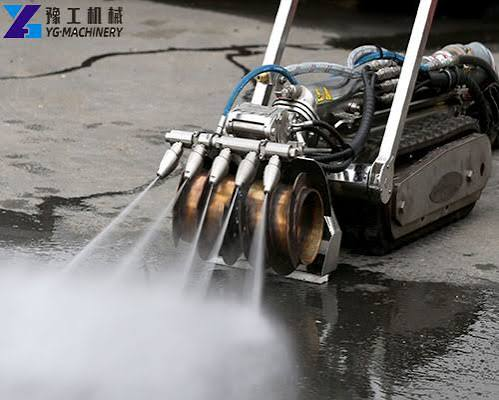
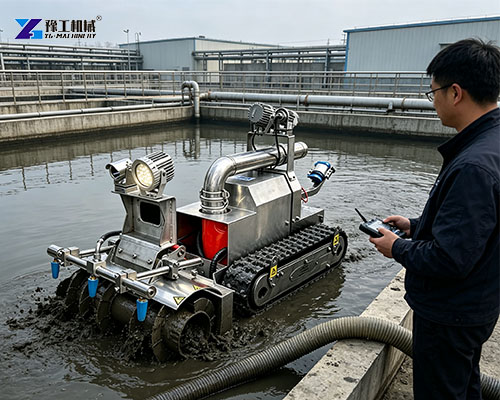
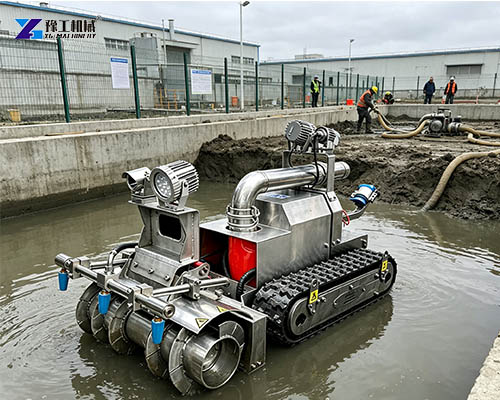
A sludge cleaning robot does one thing manual dredging cannot: it removes sediment without emptying the tank. That single difference rewrites the budget. No draining, no confined space entry, no three-week shutdown. On paper, manual dredging looks cheaper because the quote only counts labor and a pump. The real bill arrives later, in downtime, permits, disposal fees and insurance. This comparison puts both methods on the same line items, and every figure scales to the volume in your own tank.
Get Sludge Cleaning Robot Quote
The Real Cost of Manual Dredging Nobody Budgets For
A manual quote covers workers and a trash pump. Five costs stay off the page.
- Downtime. A 1,000 m³ tank goes offline 10 to 20 days — the biggest number if it feeds a line.
- Confined space entry. Permits, gas monitoring, a rescue team and ventilation add 15–25 percent to labor.
- Disposal. Wet sludge is 90 percent water, so you truck water. Dewatering cuts hauling volume 60 percent.
- Water replacement. Draining 1,000 m³ means buying and re-treating 1,000 m³ to refill.
- Rework. Crews work blind, so uneven floors and missed corners mean faster re-silting.
Dewatering is the cheapest lever; this sediment dewatering guide covers bag and belt options.
What a Sludge Cleaning Robot Changes on Site
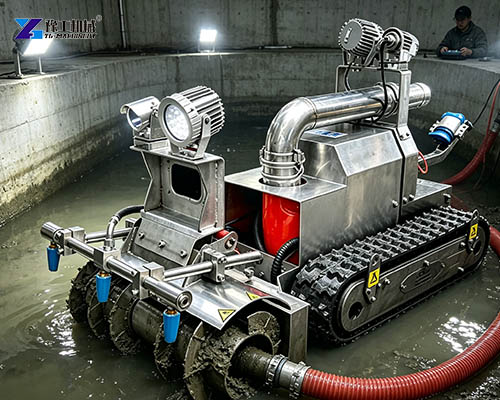
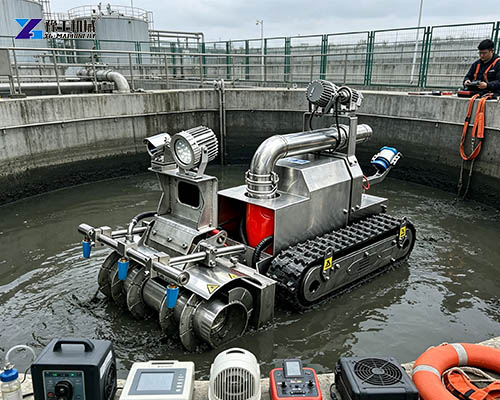
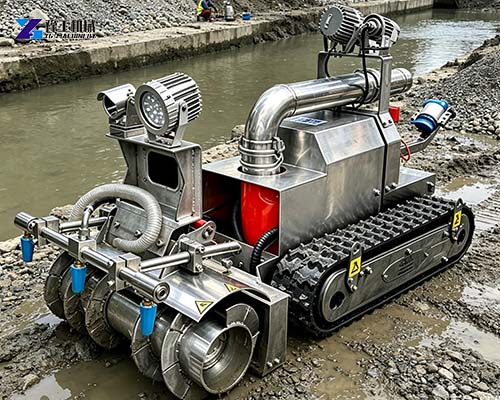
A tracked unit drives on the tank floor while the tank stays full. It cuts sediment with a rotating head and lifts it through a pump intake, all underwater. Two LED lights show the cut live.
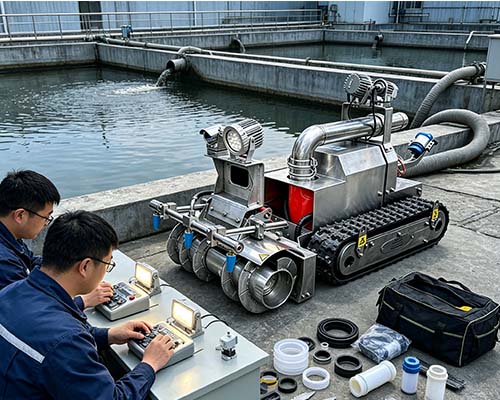
Nobody enters the tank. The operator stands on the bank with a wireless remote.
Three things change:
- Water level untouched. Fish, biology and temperature stay put.
- No entry permit. The hazard stays in the tank while the person stays out.
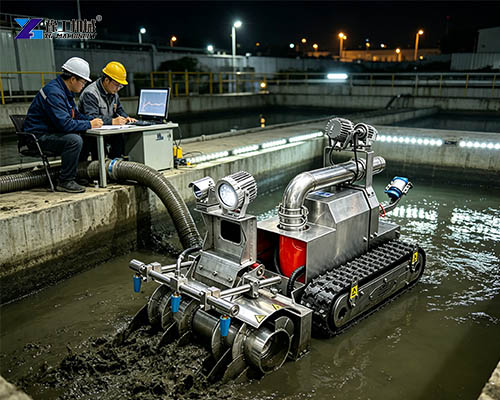
- Production continues. Work runs overnight or between batches.
That last point carries the value: a tank that never goes offline has no downtime line in the budget.
Cost Comparison: Robot vs Manual, Per Cubic Meter
Same job, costed both ways, per cubic meter.
| Cost line | Manual dredging | Sludge cleaning robot |
| Labor | 12–20 USD/m³ | 1–2 USD/m³ |
| Downtime | 8–18 USD/m³ | 0 |
| Permits and safety | 3–6 USD/m³ | 0.5 USD/m³ |
| Disposal, wet haul | 6–12 USD/m³ | 3–5 USD/m³, dewatered |
| Water replacement | 2–4 USD/m³ | 0 |
| Total | 31–60 USD/m³ | 6–12 USD/m³ |
On a 1,000 m³ tank the gap runs USD 25,000 to 48,000 per campaign. The machine costs less than the difference and works the next tank.
Safety: Confined Space Entry vs Remote Operation
Sludge tanks concentrate the worst gases in any plant.
- Hydrogen sulfide irritates eyes at 10 ppm. Above 100 ppm it deadens your sense of smell, the body’s only warning.
- Oxygen below 19.5 percent is immediately dangerous to life.
- Sediment traps gas. A tank safe at the hatch can read lethal 30 cm above the sludge.
Manual dredging requires entry. An underwater dredging robot removes it, so the permit, the rescue team and the standby watcher leave the job. Insurers notice; several clients report lower premiums. The remote control dredger operation guide explains the safe envelope.
Efficiency: How Many Days on Site
Throughput is not the pump flow on the spec sheet. It is flow times solids times hours. At 20 percent solids, a 200 m³/h pump moves 40 m³ of real sludge per hour.
| Model | Pump flow | Sludge per hour | 1,000 m³ needs |
| YG500/600 | 100 m³/h | 20 m³ | 50 hours |
| YG700/800 | 160 m³/h | 32 m³ | 31 hours |
| YG900 | 200 m³/h | 40 m³ | 25 hours |
| YG1200 | 250 m³/h | 50 m³ | 20 hours |
At eight hours a night, that is three to seven nights instead of three weeks. Start with this pond sludge volume calculation guide.
Which Underwater Dredging Robot Fits Your Tank
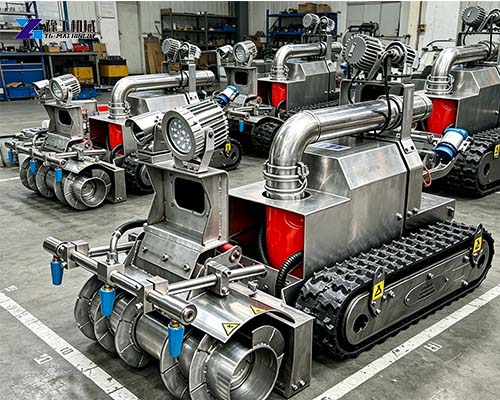
Six models cover 500 to 1,200 mm. Match the width to your tank, not your budget.
| Parameter | YG500 | YG600 | YG700 | YG800 | YG900 | YG1200 |
| Robot Dimensions (mm) | 1500*500*650 | 1500*600*650 | 1600*700*650 | 1600*850*700 | 1650*960*750 | 1900*1200*750 |
| Dredging Width (mm) | 500 | 600 | 700 | 800 | 900 | Suitable for large culverts |
| Travel Speed (m/s) | 3–15 | 3–15 | 3–15 | 3–15 | 3–15 | 0–17 m/min |
| Pump Diameter (inch) | 3 | 3 | 4 | 4 | 4 | 4or6 |
| Pump Flow (m³/h) | 100 | 100 | 160 | 160 | 200 | 250 |
| Pump Head (m) | 0–30 | 0–30 | 0–25 | 0–25 | 0–25 | 0–30 (Horizontal: 100–150m) |
| Hydraulic Station Dimensions (mm) | 2200*1200*1700 | 2200*1200*1700 | 2200*1200*1700 | 2200*1200*1700 | 2200*1200*1700 | 2120*1240*1200 |
| Main Motor Power (kW) | 18 | 18 | 22 | 22 | 22 | 45KW (50KW) or Diesel 76KW (123KW) |
| Hydraulic System Pressure (Mpa) | 0–16 | 0–16 | 0–16 | 0–16 | 0–16 | Not specified |
| Particle Size (mm) | 15 | 15 | 40 | 40 | 50 | 0–40 (customizable) |
| Winch Speed (r/min) | 0–10 | 0–10 | 0–10 | 0–10 | 0–10 | 0–10 |
| Pipe Length (m) | 30–50 Optional | 30–50 Optional | 30–50 Optional | 30–50 Optional | 30–50 Optional | 30m/pack, 20kg pressure-resistant, optional |
| Control System | Wireless Remote | Wireless Remote | Wireless Remote | Wireless Remote | Wireless Remote | Wireless Remote |
| Lighting System | Underwater LED*2 | Underwater LED*2 | Underwater LED*2 | Underwater LED*2 | Underwater LED*2 | Underwater LED*2 |
All six share 0–16 Mpa pressure, a 0–10 r/min winch, wireless remote control and two LED lights.
Three rules decide it:
- Narrower than 3 m — YG500 or YG600. Anything wider scrapes the wall.
- 3 to 6 m — YG700 or YG800. Most industrial tanks land here.
- Over 6 m, or culverts — YG900 or YG1200. The 1200 takes a 6-inch pump.
Inside a Tank Cleaning Robot System: What Ships
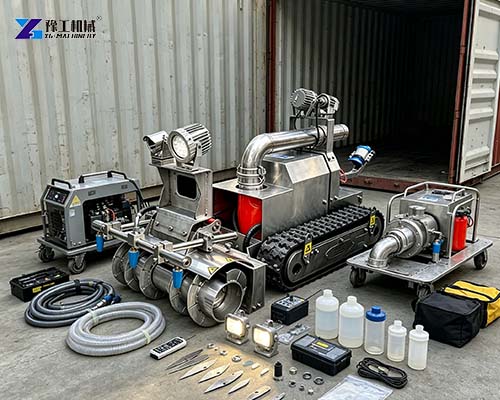
A tank cleaning robot system is more than the robot.
- Tracked body with cutter head and pump intake
- Hydraulic power station on a skid
- 30–50 m hose, in 30 m sections at 20 kg
- Wireless remote with a spare battery
- Two underwater LED lights
- Spare blades, seals, filters and a toolkit
- Manual and commissioning video
The set loads into one 20-foot container at 2.5 tons, tested before shipment.
When Manual Dredging Still Makes Sense
A robot is not always the answer, and saying otherwise wastes money.
- Water shallower than 50 cm. The body is 650 mm tall and cannot submerge.
- Heavy gravel or rock. The cutter handles sludge and soft silt, not stone.
- Under 50 m³ total. Mobilization outweighs the savings.
- No access ramp. The robot has to drive in.
If two or more apply, rent a vac truck and revisit later.
Sludge Cleaning Robot FAQ: 5 Buyer Questions
What is the minimum water depth?
About 50 cm above the sediment. Below that the body breaks the surface and pulls air.
Can it handle sand and grit?
Yes, up to the table’s particle size: 15 mm on YG500/600, 40 mm on YG700/800, 50 mm on YG900.
How much power does it draw?
The main motor is 18–45 kW. Most sites run 380V three-phase; a diesel unit suits YG1200.
What about spare parts?
Blades, seals and filters ship with every order. We hold stock for models in production.
How long is delivery?
Standard models ship in 20 to 30 days. Custom width or a diesel pack adds two weeks.
Get a Side-by-Side Comparison for Your Tank
Send three numbers: tank length, width and sediment depth. We return a model recommendation, a days-on-site estimate and a cost per m³ for both.
Error: Contact form not found.