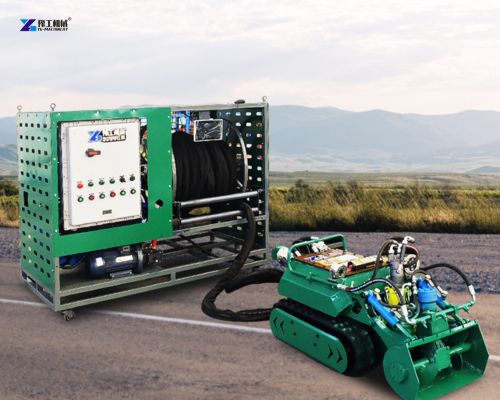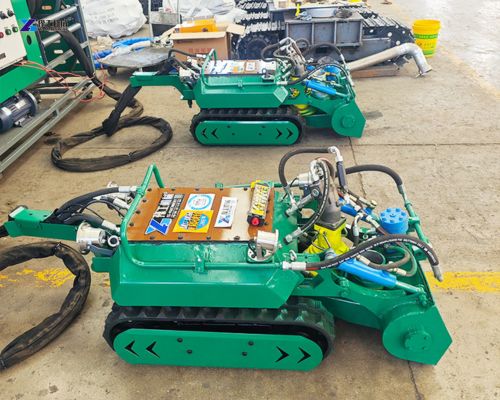
An underwater dredging robot is a tracked machine that drives along a pond or tank floor, loosens settled sludge, and pumps it out while the pool stays full. The robot works underwater. The pump and hydraulic station stay on the bank, linked by a 50 metre hose. One operator runs it from a wireless remote on the deck. Water plants, power stations, and settling ponds use it to clear silt without draining, entering, or shutting down. Tell us your pond size and sludge depth, and YG will size the unit.
Get a Underwater Dredging Robot Quote
What Is an Underwater Dredging Robot
Three parts make up the system, and only one goes in the water.
- The robot. A tracked chassis of 320 to 500 kg, carrying a suction head and an agitation head.
- The hydraulic station. Sits on the bank, driven by a 22 to 45 kW motor.
- The hose reel and remote. 50 metres of hose as standard.
That split explains why a 380 kg robot moves 200 m³ of slurry an hour. The pump sits on the bank, and the hose carries the slurry out.
Specifications: YG-500 to YG-1200
| Model | YG-500 | YG-600 | YG-700 | YG-800 | YG-900 | YG-1200 |
| Robot dimensions | 1500*500*650mm | 1500*600*650mm | 1600*700*650mm | 1600*850*700mm | 1650*960*750mm | 1900*1200*750mm |
| Dredging width | 500mm | 600mm | 700mm | 800mm | 900mm | 1200mm |
| Track travel speed | 3-15m/s | 3-15m/s | 3-15m/s | 3-15m/s | 3-15m/s | 3-15m/s |
| Robot weight | 320kg | 350kg | 380kg | 400kg | 420kg | 500kg |
| Pump output diameter | 3inch | 3inch | 4inch | 4inch | 4inch | 4inch |
| Pump flow rate(cubic meters/ hour) | 100 m³ | 100m³ | 200m³ | 200m³ | 200m³ | 200m³ |
| Hydraulic station dimensions(mm) | 2200*1200*1700 | 2200*1200*1700 | 2200*1200*1700 | 2200*1200*1700 | 2200*1200*1700 | 2120*1240*1200 |
| Main motor power | 22kw | 22kw | 30kw | 30kw | 30kw | 45kw |
| Hydraulic system pressure | 0-16Mpa | |||||
| Particle size | 15mm | 15mm | 38mm | 38mm | 38mm | 60mm |
| Reeling system speed | 0-10r/min | |||||
| Hydraulic hoses | 50m (Standard configuration) | |||||
| Control system | Wireless remote control | |||||
| Lighting system | Underwater LED lights *2 | |||||
Six models run from 500 to 1200 mm of dredging width. The first two use a 3 inch pump at 100 m³/h, the rest a 4 inch pump at 200 m³/h. Particle size splits at 15, 38, and 60 mm.
Key Features of the Underwater Dredging Robot
Five traits, each solving a specific problem.
- Tracked travel at 3 to 15 m/min. Slow on purpose, because soft sludge needs torque, not speed.
- Wireless remote. The operator stands on the bank and sees the whole pond.
- Two underwater LED lights. Work continues where visibility drops below 300 mm.
- Hydraulic drive at 0 to 16 MPa. No electric motor underwater means no shaft seal to fail.
- 50 metres of hose as standard. Most ponds are covered from one setup point.
How the Robot Is Built
- Tracked chassis. Wide tracks spread the weight, so the robot sits on soft sludge instead of sinking in.
- Agitation head. Jets water into the silt to lift it into suspension.
- Suction head. Takes slurry behind the agitator, at a density the pump can move.
- Hydraulic station. The 22 to 45 kW motor drives the pump and the tracks.
- Hose reel. Keeps the line off the floor so it does not snag.
Agitate without suction and the silt settles back. Suction without agitation and you pull clear water.
Choosing the Right Crawler Cleaning Robot
- Dredging width against pond shape. A narrow rectangular tank suits 500 to 700 mm. A wide basin needs 900 to 1200 mm to cover the floor in fewer passes.
- Pump flow against sludge type. Fine organic sludge moves at 100 m³/h. Sand and compacted sediment need 200 m³/h.
- Particle size against what is on the floor. 15 mm handles silt, 38 mm takes grit, 60 mm handles rubble.
表格
| Pond Type | Typical Floor | Recommended Model |
|---|---|---|
| Water plant settling basin | Fine alum sludge | YG-500 or YG-600 |
| Power station cooling pond | Grit and scale | YG-700 or YG-800 |
| Industrial settling tank | Mixed slurry | YG-800 or YG-900 |
| Port basin and channel | Sand, rubble | YG-1200 |
🔘 [Send Your Pond Dimensions for a Match →]
Where a Tank Cleaning Robot Replaces Manual Desludging
- Water treatment basins. Alum sludge builds 300 to 800 mm a year. Draining one takes it offline for a week.
- Power station cooling ponds. Scale collects in low corners, and divers work in near-zero visibility.
- Industrial settling tanks. Red mud, mill scale, paper fibre. All too thick for a pump alone.
- Port basins and channels. Silt returns every tide. A crawler cleaning robot working from the quay clears it without closing the berth.
One water utility in Jeddah runs three basins, each 40 by 25 metres and 5.5 metres deep, with 0.8 to 1.4 metres of sludge. Manual cleaning meant draining one, ventilating it, sending three men down, and losing four to five days of capacity.
They bought a YG-700 in early 2025. The basin stays full, one operator works from the deck, and a single basin takes 18 hours.
“We used to plan the whole plant around one basin shutdown. Now we clean at night and nobody notices.” — Operations manager, Jeddah
Frequently Asked Questions
- Does the pond have to be drained?
No. The robot works fully submerged, which is why buyers pick it over an excavator.
- How deep can it reach?
50 metres of hose as standard. Deeper sites need a longer line and larger reel, quoted per project.
- Where does the sludge go?
To a dewatering bag, settlement tank, or tanker, depending on what you run on site.
- What maintenance does it need?
Track tension and hose inspection after each job, oil and filter at 500 hours. No underwater seals to service.
- How does it ship?
Robot, hydraulic station, and reel load into one 20 foot container.
🔘 [Ask About Delivery and Spare Parts →]
Underwater Dredging Robot for Sale — YG Machinery
YG builds the YG-500 to YG-1200 range for working widths of 500 to 1200 mm, with pump flow from 100 to 200 m³/h. Units ship with a 50 metre hose, wireless remote, and spare suction head.
Tell us the pond dimensions, the sludge depth, and what the sludge is made of. We will confirm the model and quote the landed cost.