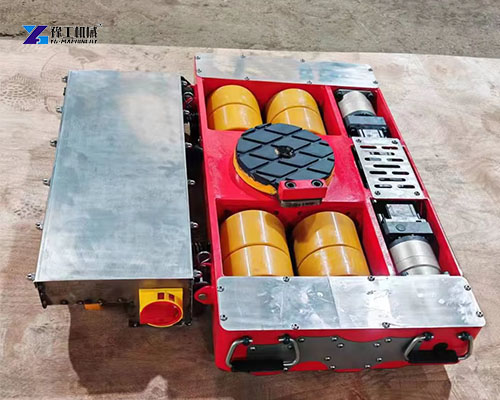
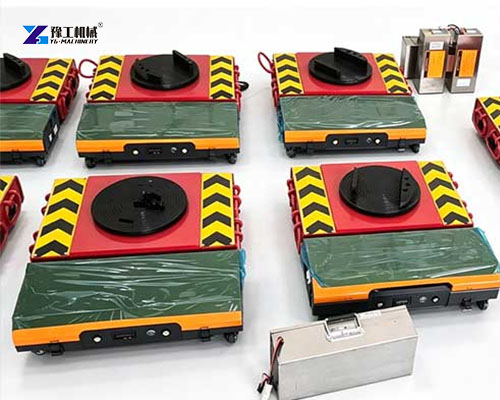
An electric transfer trolley is a battery-powered transport solution for moving heavy machinery and industrial loads inside factories, workshops, and warehouses. It is commonly used for CNC machines, molds, transformers, presses, and other large equipment. With remote control, a low-profile structure, strong load capacity, and flexible movement, it can simplify heavy-duty handling where forklifts or towing vehicles are difficult to use. For buyers looking for a safer and more efficient way to move heavy loads, YG provides practical trolley solutions based on load weight, floor conditions, and working requirements.
Electric Transfer Cart Capacity and Model Selection
Capacity is one of the first specifications B2B buyers should check. However, the rated capacity should not be treated as the only selection factor.
A general selection range can include:
| Model | YG-10 | YG-20 | YG-30 | YG-40 | YG-50 | YG-60 |
| Dimension(mm) | 500*550*145 | 670*620*165 | 740*640*185 | 810*800*182 | 810*800*182 | 1110*880*185 |
| Motor(2 sets with brake) | 500w | 750w | 1000w | 1 500w | 2000w | 3 000w |
| Controller | Dual driver D2T80A | Dual driver D2T80A | Dual driver D2T100A | Dual driver D2T200A | Dual driver D2T200A | Dual driver D2T200A |
| Battery | 48V 30AH (ternary lithium ) | 48V 60AH (ternary lithium or lithium iron phosphate) | 48V 60AH (ternary lithium or lithium iron phosphate) | 48V 120AH (ternary lithium or lithium iron phosphate) | 48V 120AH (ternary lithium or lithium iron phosphate) | 48V 100AH (ternary lithium ) |
| working current | 25A | 60A | 60A | 150A | 150A | 150A |
| Maximum towing weight | 10t | 20t | 30t | 40t | 50t | 60t |
| Plate | 10 mm Q355 steel | 10 mm Q355 steel | 12 mm Q355 steel | 16 mm Q355 steel | 16 mm Q355 steel | 16 mm Q355 steel |
| Drive wheel | 4 | 4 | 4 | 4 | 4 | 8 |
For example, if a machine weighs 25 tons, a 30-ton-class trolley may be a more practical choice than a 20-ton model. Extra capacity can provide a useful margin when the load is uneven or the center of gravity is not perfectly balanced.
The operating environment also matters. A trolley moving a heavy load on a flat concrete floor has different requirements from one working on a sloped or uneven surface.
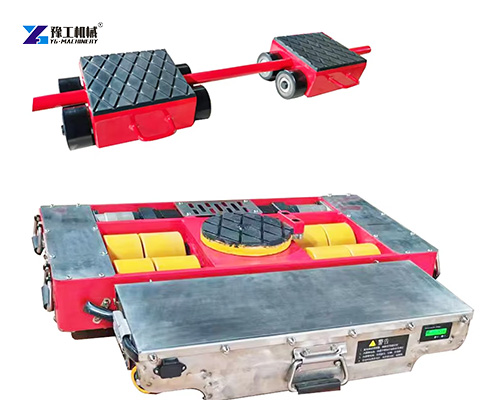

Key Features of a Battery Powered Electric Transfer Trolley
A tank-type transfer trolley is designed for heavy-duty industrial movement. Its main features include:
- Battery powered: No continuous power cable is required during operation.
- Heavy load capacity: Models can be selected for different industrial loads.
- Remote control: Operators can control forward, reverse, steering, and stopping.
- Compact structure: Suitable for factories with limited working space.
- Low-profile platform: Makes it easier to handle machines with low bottom clearance.
- Flexible movement: Suitable for short-distance transport and positioning.
- Custom configurations: Battery, motor, platform size, wheels, and controls can be matched to the application.
The right configuration depends on more than load weight. Floor conditions, turning space, travel distance, and operating frequency should also be considered.
Machine Moving Skates for Different Factory Applications
Machine moving skates are commonly considered when conventional material-handling equipment is difficult to use.
Typical applications include:
- CNC machines
- Injection molding machines
- Industrial molds
- Press machines
- Transformers
- Steel structures
- Production line equipment
- Heavy warehouse cargo
The key question is not simply whether the load is heavy.
The better question is whether the trolley matches the load, floor, space, and handling process.
For example, if a 15-ton machine only needs to move 30 meters inside a workshop, a compact battery powered solution may be more practical than using a large forklift for every transfer.
Before ordering, check these points:
| Item | What to Confirm |
|---|---|
| Load weight | Actual operating weight |
| Machine size | Length, width, and height |
| Load center | Center and distribution of weight |
| Bottom clearance | Space available below the machine |
| Floor | Concrete, epoxy, steel, etc. |
| Floor slope | Level or inclined |
| Turning space | Available operating area |
| Working hours | Occasional or continuous use |
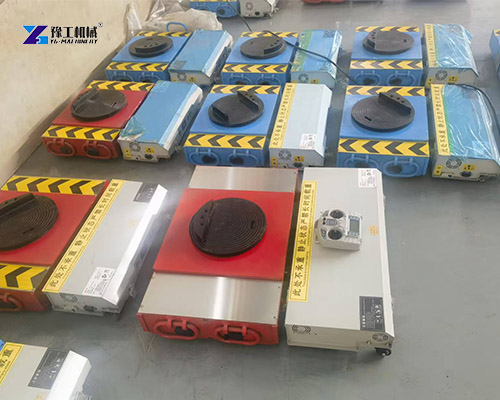

Two Real-World Electric Transfer Trolley Cases
Case 1: Heavy Machinery Moving in a U.S. Factory
A U.S. industrial customer needed to move heavy machinery inside a factory.
The main challenge was limited working space. Traditional towing equipment required additional room and made positioning more difficult around existing machines.
The customer used a battery powered load moving skate for internal equipment transportation. Remote control allowed the operator to control the movement from a suitable position.
The compact design helped the customer move the equipment through the workshop without depending entirely on a separate towing vehicle.
This case shows why buyers should evaluate the complete working route, rather than choosing equipment based only on load capacity.
Case 2: 20-Ton Equipment Moving Solution
A 20-ton industrial machine needed to be moved over a short distance inside a workshop.
The solution focused on three main factors: load capacity, floor conditions, and maneuverability.
A 20-ton-class electric transfer cart provided battery-powered movement and remote control. The equipment could be moved and positioned without using a conventional towing vehicle for the entire process.
For this type of project, the machine’s center of gravity and bottom clearance are especially important. A correct capacity rating alone does not guarantee that the trolley will be suitable.
Key Specifications to Check Before Buying an Electric Transfer Trolley
Before making a purchase, compare the following specifications:
| Specification | Why It Matters |
|---|---|
| Load capacity | Determines the maximum working load |
| Battery capacity | Affects operating time and charging frequency |
| Motor power | Influences traction and movement performance |
| Platform size | Must match the equipment dimensions |
| Ground clearance | Determines whether the trolley can fit under the load |
| Wheel type | Should match the floor and load conditions |
| Control system | Affects operating convenience and safety |
| Travel speed | Should match the factory working environment |
Do not focus on one specification alone. The complete trolley system should match the actual application.
How Much Can an Electric Transfer Cart Save?
The initial purchase price is only part of the cost.
A simple comparison is:
Handling Cost = Labor + Forklift + Towing Equipment + Downtime
An electric transfer cart may reduce dependence on several of these resources.
For example, a factory that normally uses a forklift and several workers for equipment positioning may be able to simplify the process with a dedicated battery-powered trolley.
The potential benefit also comes from flexibility. The forklift can remain available for other warehouse tasks, while the transfer trolley handles repeated heavy-load movement.
For B2B buyers, it is better to compare the total handling cost over several years rather than focusing only on the initial equipment price.
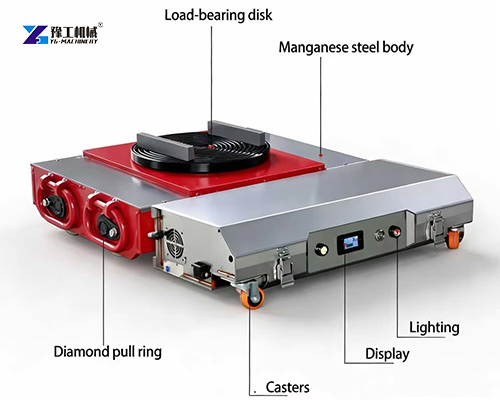
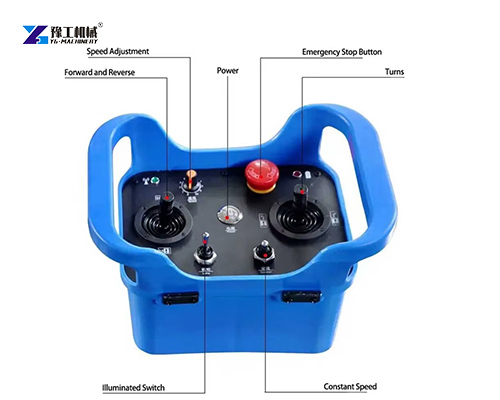
How to Order an Electric Transfer Trolley
A detailed inquiry helps the manufacturer recommend the right solution.
Step 1: Provide Load Weight
Give the actual machine or cargo weight.
Step 2: Provide Machine Dimensions
Include length, width, height, and photos if available.
Step 3: Confirm Bottom Clearance
Measure the available space under the equipment.
Step 4: Describe the Floor
Provide information about floor material, slope, flatness, and load-bearing capacity.
Step 5: Explain the Working Cycle
Tell the manufacturer how often the trolley will operate, how far it will travel, and whether frequent turning or positioning is required.
For overseas buyers, these details can make the quotation process much faster and reduce unnecessary communication.
Electric Transfer Trolley FAQ
What is an electric transfer trolley used for?
It is mainly used to move heavy machinery and industrial loads across factories, workshops, and warehouses. Common applications include CNC machines, molds, transformers, presses, and production equipment.
How do I choose the right trolley capacity?
Start with the actual load weight and then consider load distribution, floor conditions, travel distance, and working frequency. A suitable capacity margin should be included for practical operation.
Can a battery powered load moving skate work on epoxy floors?
It can be suitable for epoxy floors when the wheel type and load conditions are correctly matched. Buyers should provide information about the floor so the manufacturer can recommend an appropriate wheel configuration.
How long can an electric transfer cart operate on one charge?
Operating time depends on battery capacity, load weight, travel distance, speed, floor conditions, and the number of operating cycles. The manufacturer can estimate battery requirements based on the expected daily workload.
Can the trolley be customized for different machines?
Yes. The platform size, load capacity, motor, battery, wheels, control system, and other specifications can be selected according to the machine and working environment.