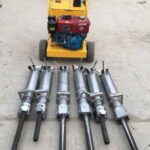


An excavator rock drill and splitter is designed for projects that require controlled rock excavation without relying on conventional blasting. By combining drilling and hydraulic splitting in one excavator-mounted system, it allows contractors to drill into hard rock and create cracks for easier removal. However, choosing the right machine involves more than comparing splitting force or price. Buyers need to consider excavator compatibility, rock conditions, drilling capacity, working space, maintenance, and expected output. This guide explains how to evaluate these factors before purchasing equipment for your construction, quarrying, or mining project.
Get a Excavator Rock Drill and Splitter Quote
Excavator Rock Drill & Splitter Parameters
| Model | YG-130 | YG-152 | YG-210 |
| Suitable Excavator | 20T-36T Excavator | 36T-48T Excavator | 48T-65T Excavator |
| Maximum Horizontal Splitting Height | 9475mm | 9985mm | 10680mm |
| Maximum Vertical Splitting Height | 6715mm | 6905mm | 6770mm |
| Maximum Splitting Depth | 6705mm | 7025mm | 8050mm |
| Maximum Splitting Distance | 10225mm | 10875mm | 11640mm |
| Pilling Beam Length | 3875mm | 4850mm | 5525mm |
| Drilling Advance Stroke | 2000mm | 2600mm | 3500mm |
| Maximum Drilling Thrust Force | 50KN | 50KN | 50KN |
| Maximum Drilling Pull Force | 32KN | 32KN | 32KN |
| Piling Advance Stroke | 1500mm | 1800mm | 2300mm |
| Maximum Piling Thrust Force | 160KN | 160KN | 160KN |
| Maximum Piling Full Force | 100KN | 100KN | 100KN |
| Hydraulic Pressure | Max. 35Mpa | Max. 35Mpa | Max. 35Mpa |
| Hydraulic Flow | Min. 240L/min | Min. 240L/min | Min. 240L/min |
| Weight | 4200kg | 6200kg | 8300kg |
| Dimensions | 4210*1400*1785mm | 5270*1485*1840mm | 5810*1485*1840mm |
| Operation Mode | Remote Control | Remote Control | Remote Control |
Request an Excavator Rock Drill and Splitter Quote


Where Is a Rock Splitter for Excavator Used?
A rock splitter for excavator projects can be considered for several applications where conventional breaking methods present operational challenges.
- Quarrying and mining: Splitting hard rock into manageable sections for excavation and handling.
- Road construction: Removing rock along road cuts, slopes, and drainage routes.
- Foundation excavation: Breaking rock in building foundations and construction pits.
- Tunneling and underground work: Supporting controlled rock removal where space and vibration require careful management.
- Restricted urban sites: Providing a non-explosive alternative when nearby buildings or infrastructure limit excavation methods.
The most suitable application depends on the geology, available working space, production target, and project restrictions. Hydraulic splitting is not automatically the fastest or cheapest method for every site. Compare it with blasting, hydraulic breakers, and other suitable excavation methods before making a decision.
Request an Excavator Rock Drill and Splitter Quote


How Does an IADS Integrated Auto Drilling & Splitter Work?
An IADS (Integrated Auto Drilling & Splitter) system combines drilling and rock splitting into an integrated workflow. Instead of moving between a separate drilling machine and a separate splitting unit, the operator can perform both operations using the integrated equipment, subject to its design and control system.
The main potential advantages include:
- Fewer equipment changes between drilling and splitting.
- Less coordination between separate machines.
- A more continuous working process.
- Reduced equipment movement between operations.
- More convenient positioning when the attachment is designed for the site conditions.
However, integration does not guarantee a specific increase in productivity. Drilling time, hole layout, rock fractures, excavator positioning, and material removal still affect the total cycle.
Before purchasing an IADS system, ask the manufacturer which functions are automated, which require operator intervention, and whether remote control, dust suppression, or positioning features are included in the quoted configuration.
Request an Excavator Rock Drill and Splitter Quote
Excavator Rock Drill and Splitter Specifications to Compare
Before comparing prices, prepare a specification checklist. It helps you identify differences between models and avoid buying equipment that cannot meet your project requirements.
| Specification | What to Check |
|---|---|
| Compatible excavator weight | Approved carrier range and stability |
| Hydraulic flow and pressure | Match with the excavator’s auxiliary circuit |
| Attachment weight | Lifting capacity and working reach |
| Drilling diameter | Compatibility with the splitting mechanism |
| Maximum drilling depth | Suitability for the required excavation depth |
| Splitting force | Capability for the target rock conditions |
| Rotation and positioning | Access to different parts of the rock face |
| Wear parts and service | Replacement intervals, availability, and cost |
Do not assume that a higher splitting-force rating always means higher daily output. If drilling is slow or the separated rock is difficult to remove, the complete process may remain inefficient.
Request a technical datasheet and a written compatibility confirmation before placing your order.
Rock Splitter for Excavator vs. Hydraulic Rock Breaker
Both attachments can break rock, but they work differently and suit different tasks.
| Comparison | Rock Drill and Splitter | Hydraulic Rock Breaker |
|---|---|---|
| Working principle | Drilling followed by internal hydraulic splitting | Repeated impact on the rock surface |
| Preparation | Requires suitable drilled holes | Usually works directly on the exposed material |
| Typical priority | Controlled cracking and planned splitting | General rock breaking and secondary reduction |
| Workflow | Includes drilling, splitting, and removal | Includes impact breaking and material removal |
| Selection factors | Rock structure, hole layout, splitting requirements | Rock hardness, impact requirements, and carrier match |
A drill-and-split system may be worth considering when blasting is restricted or controlled cracking is important. A hydraulic breaker may be more practical for irregular rock, general demolition, or secondary breaking.
Some projects can use both methods: splitting to open a rock face, followed by a breaker to reduce oversized pieces. The best choice depends on site conditions rather than a universal performance ranking.
Operating Costs and Maintenance of an Excavator Rock Drill and Splitter
The purchase price is only one part of the total cost. Overseas buyers should also estimate drilling consumables, wear parts, fuel, labor, maintenance, downtime, and shipping costs for replacement components.
A useful comparison is the cost per cubic meter of rock removed:
Cost per m³ = Total operating cost ÷ Volume of rock removed
For example, if a project incurs $1,200 in operating costs and removes 300 m³ of rock during the same period, the operating cost is $4 per m³. This is an illustrative calculation, not a verified YG machine performance result.
To control operating costs:
- Inspect drill bits, hoses, connections, and wear components regularly.
- Follow the manufacturer’s hydraulic oil and lubrication requirements.
- Keep drilled holes within the specified diameter and depth.
- Train operators to follow the correct drilling and splitting sequence.
- Confirm spare-parts availability and after-sales support before purchasing.
Request an Excavator Rock Drill and Splitter Quote
Why Choose YG as Your Excavator Rock Drill and Splitter Manufacturer?
Choosing a manufacturer should involve more than comparing quotations. The supplier should understand your excavator, rock conditions, and project requirements before recommending a configuration.
When contacting YG, prepare your excavator make and model, operating weight, hydraulic flow and pressure, rock type, required drilling depth, and project location. Photos or videos of the rock face can also help explain the working conditions.
Ask for the applicable technical datasheet, mounting details, installation guidance, warranty terms, and spare-parts information. These details make it easier to compare suppliers and reduce the risk of compatibility problems after delivery.
Request an Excavator Rock Drill and Splitter Quote


Frequently Asked Questions About Excavator Rock Drill and Splitter
1. Can an excavator rock drill and splitter fit my existing excavator?
It may fit if the excavator meets the attachment’s weight, hydraulic flow, pressure, lifting capacity, and mounting requirements. Provide your machine details to the manufacturer for confirmation.
2. What types of rock can an excavator rock splitter handle?
Suitability depends on rock hardness, fractures, abrasiveness, and the machine configuration. Ask the supplier to assess your specific geology rather than relying on a general list of rock types.
3. What is the difference between IADS and separate drilling and splitting equipment?
An integrated IADS system combines drilling and splitting into one coordinated setup. Separate equipment offers independent machine selection but may require additional movement and coordination between operations.
4. Is a rock splitter suitable when blasting is restricted?
It can be an alternative for controlled, non-explosive rock excavation. However, contractors must still assess vibration, noise, dust, falling-rock hazards, and local site safety requirements.
5. What affects the operating cost of a rock splitter for excavator projects?
Major factors include drilling time, consumable wear, labor, fuel, maintenance, downtime, and the volume of rock removed. Compare total operating cost per cubic meter for a meaningful evaluation.